

If you’ve ever received a scam text claiming to be from your bank, a robocall pretending to be the IRS, or a suspicious call from an unknown number, you’ve probably wondered the same thing many consumers do:
What am I supposed to do about this?
For years, reporting spam calls and texts has been surprisingly confusing. Should you contact your wireless carrier? Should you report it to Apple or Google? Should you notify the company being impersonated? In many cases, people simply delete the message or block the number and move on.
During a recent television interview discussing the launch of the National Spam Reporting Center, YouMail CEO Alex Quilici explained why consumers need a simpler way to fight back.
You can watch the full interview here.
The reality is that spam calls, scam texts, and phone-based fraud continue to affect millions of Americans every day. While blocking unwanted calls is important, reporting suspicious activity can help stop scammers from targeting other people as well.
That is one of the reasons platforms like YouMail and the National Spam Reporting Center were created.
Most people don’t know where to report spam
One of the biggest challenges consumers face is uncertainty.
When a suspicious call or text arrives, most people have no idea where the report should go. A scammer may be impersonating a bank, a government agency, a delivery service, or a wireless carrier. Determining who should receive the complaint often becomes more work than the report itself.
As Quilici explained during the interview, consumers frequently find themselves asking questions like:
- Should I tell my carrier?
- Should I tell Apple or Google?
- Should I tell the bank?
- Is there even a point in reporting it?
That confusion creates a major problem because many scam campaigns depend on remaining active long enough to target thousands or even millions of people.
When reporting becomes difficult, fewer people do it.
The result is less visibility into emerging scams and slower responses from organizations that may be able to help stop them.
Why reporting matters
Many people assume that reporting a spam call only helps them.
In reality, the value of reporting extends far beyond a single phone number.
Every report contributes to a larger picture that helps identify trends, detect active scam campaigns, and uncover patterns that may not be obvious from a single complaint. When enough reports point to the same operation, investigators, carriers, and security teams can often take action more quickly.
This becomes especially important because scammers rarely rely on just one number.
Modern scam operations frequently rotate through thousands of phone numbers, spoof local area codes, and launch coordinated campaigns that change constantly. Looking at reports collectively makes it easier to identify the campaign itself rather than focusing only on individual phone numbers.
That broader perspective is one of the reasons YouMail continues investing in tools that make reporting easier and faster.
What happens after you submit a report?
One of the most common questions people ask is what actually happens after they report a suspicious call or text.
According to Quilici, the goal of the National Spam Reporting Center is to make reporting simple while ensuring the information can be used effectively.
When someone submits a report, the information can be reviewed and shared with organizations that may be able to take action. Depending on the situation, this may include carriers, regulators, enforcement organizations, financial institutions, or other partners.
The process is designed to be straightforward.
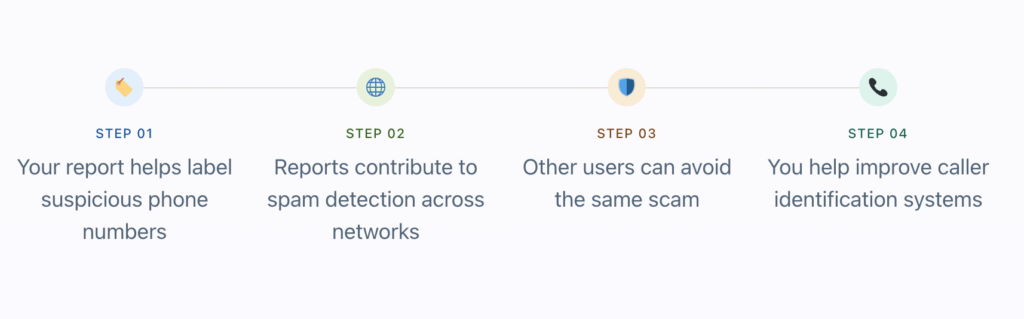
Rather than forcing users through lengthy forms or account creation steps, reports can be submitted quickly so consumers can spend less time navigating systems and more time helping stop unwanted activity.
This approach is intended to remove friction while increasing the amount of useful intelligence available to those fighting scam operations.
More information about the reporting initiative was also discussed during the television segment.
More reports mean faster scam detection
The effectiveness of any scam prevention effort depends heavily on data.
When only a small group of people report suspicious activity, it can take longer to identify new campaigns. Expanding reporting to a broader audience increases visibility and helps surface threats sooner.
Quilici noted that YouMail already receives valuable information from users of the YouMail app. However, opening reporting capabilities to everyone creates opportunities to identify emerging scams more quickly and respond before they spread further.
This is particularly important as scam tactics continue evolving.
Today’s fraud campaigns often combine caller ID spoofing, automated dialing systems, impersonation techniques, and AI-generated content. Detecting these operations early can help reduce their effectiveness and limit the number of potential victims.
The sooner suspicious activity is identified, the sooner defensive measures can be deployed.
Will scam calls ever disappear completely?
One of the most interesting moments in the interview came when Quilici was asked whether scam calls could ever be eliminated entirely.
His answer was realistic.
Scams are unlikely to disappear completely, just as other forms of crime continue to exist despite ongoing prevention efforts. However, reducing volume and making scams less successful can still create meaningful improvements for consumers.
The goal is not perfection.
The goal is fewer scam calls, fewer successful fraud attempts, and stronger protections that make life more difficult for bad actors.
Over time, better detection systems, improved reporting, stronger enforcement efforts, and greater consumer awareness can all contribute to lowering the overall impact of scam campaigns.
That progress matters even if the problem never reaches zero.
How consumers can help fight back
Consumers play an important role in the effort to reduce spam and scam activity.
Simple actions can make a difference:
- Report suspicious calls and texts when possible.
- Avoid engaging with unknown callers requesting personal information.
- Verify organizations independently before responding.
- Never trust caller ID alone.
- Use call protection tools that help identify and block suspicious activity automatically.
Services such as YouMail combine spam detection, robocall blocking, reporting capabilities, and privacy-focused tools designed to help consumers stay ahead of evolving threats.
The more information that can be gathered about active scams, the better positioned the industry becomes to respond.
Download YouMail and instantly stop spam calls, texts, and voicemail.
Final thoughts
Spam calls and scam texts remain a frustrating reality for millions of Americans. While most people recognize the problem, many still do not know where to report suspicious activity or whether reporting will make a difference.
The launch of the National Spam Reporting Center aims to simplify that process by making reporting faster, easier, and more actionable.
As Alex Quilici explained during his recent television appearance, fighting phone-based fraud requires both better technology and greater participation from consumers. Every report contributes valuable information that can help identify emerging scams, support enforcement efforts, and improve protections for everyone.
To learn more, watch the full interview.
And for additional protection against spam calls, scam texts, and unwanted voicemail, visit YouMail.