

Americans received just over 4.1 billion robocalls in May, according to the latest data from the YouMail Robocall Index.
At first glance, that may sound like good news. Overall robocall volume declined compared to the same period last year, continuing a broader trend of lower robocall activity nationwide.
But there is another side to the story.
While robocall volume has decreased, the threat facing consumers continues to evolve. Scammers are becoming more sophisticated, more targeted, and often more effective. Rather than relying solely on massive volumes of calls, many fraudsters are focusing on personalized attacks, impersonation scams, and advanced calling techniques designed to bypass traditional protections.
That means fewer calls do not necessarily translate into less risk.
For consumers, the challenge is no longer just stopping robocalls. It is understanding how scam campaigns are changing and using tools like YouMail to stay protected as those tactics evolve.
Americans still received more than 4 billion robocalls
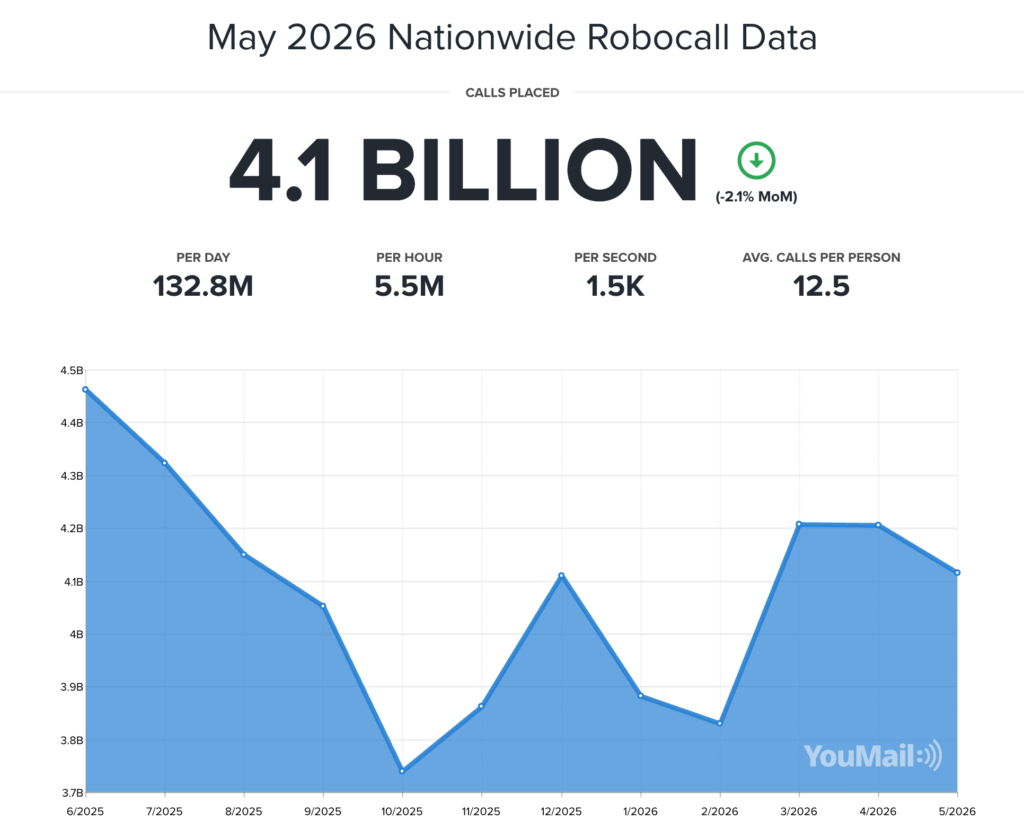
According to the latest YouMail Robocall Index report, , Americans received approximately 4.1 billion robocalls during May.
That translates to roughly:
- 132.8 million robocalls every day
- More than 5.5 million robocalls every hour
- More than 1,500 robocalls every second
Even after a year-over-year decline of nearly 15%, the scale remains enormous.
To put that into perspective, billions of unwanted calls continue reaching consumers every month. Many of these calls interrupt daily life, waste time, create confusion, and in some cases expose consumers to significant financial risks.
The robocall problem has improved, but it has not disappeared.
Why lower volume does not mean lower risk
One of the biggest mistakes consumers can make is assuming that fewer robocalls automatically means fewer scams.
Modern fraud operations are becoming increasingly efficient.
Years ago, many robocall campaigns relied on sheer volume. Fraudsters would blast millions of calls across the country and hope a small percentage of recipients would respond.
Today, many scammers focus on quality rather than quantity.
They leverage stolen consumer data, caller ID spoofing, local area codes, AI-assisted scripts, and impersonation tactics to create calls that feel more legitimate and more urgent. A scammer no longer needs millions of successful interactions if a smaller number of highly targeted victims generate significant financial returns.
This shift means that while overall robocall volume may decline, the sophistication of scam campaigns continues to increase.
Consumers who rely solely on caller ID or basic blocking tools may still find themselves vulnerable to these newer attacks.
The biggest campaigns are still reaching millions of people
The latest data demonstrates just how large modern robocall campaigns can become.
One of the most heavily reported campaigns during May involved health insurance marketing calls associated with the “InsureMe Marketplace.” The campaign generated well over 30 million calls during the month while utilizing thousands of different phone numbers.
Recipients frequently reported receiving multiple calls per day. Many of the numbers appeared local because the campaign used area code matching techniques designed to increase answer rates.
This approach highlights an important challenge facing consumers.
Blocking a single number is often ineffective because large campaigns may operate across hundreds or thousands of numbers simultaneously. As soon as one number becomes ineffective, another can quickly replace it.
That is why identifying the broader campaign behind the calls is often more important than identifying any individual phone number.
Scammers are constantly changing tactics
The robocall ecosystem continues to evolve because fraudsters are highly motivated to stay ahead of detection systems.
One tactic receiving increased attention is a practice known as snowshoeing. Instead of placing calls from a small group of numbers, callers distribute activity across thousands of different phone numbers. This reduces the likelihood that any single number accumulates enough complaints to be blocked quickly.
Caller ID spoofing remains another major challenge. Fraudsters routinely disguise their identity by displaying local numbers, trusted organizations, government agencies, financial institutions, or businesses that consumers recognize.
At the same time, AI tools are helping bad actors automate portions of their campaigns. Automated voice systems, dynamic scripting, and more convincing impersonation techniques are making it increasingly difficult for consumers to distinguish legitimate calls from fraudulent ones.
The result is a threat landscape that continues to become more sophisticated even when overall robocall volumes decline.
Why YouMail focuses on patterns instead of phone numbers
Many traditional call blocking solutions focus primarily on individual phone numbers. That approach worked better when robocallers repeatedly used the same numbers for extended periods of time. Today’s scam campaigns are far more dynamic.
Modern robocall operations constantly rotate numbers, spoof caller IDs, and shift tactics in an effort to avoid detection. That is why YouMail focuses on identifying suspicious behavior patterns rather than simply blocking individual numbers.
Using a combination of patented audio fingerprinting technology, call pattern analysis, consumer reports, and network intelligence, YouMail helps identify robocall campaigns even when the phone numbers themselves change.
This allows protection systems to adapt as scammers adapt.
Rather than playing an endless game of whack-a-mole with individual numbers, YouMail works to identify the underlying campaigns responsible for unwanted calls.
What consumers can do right now
Although scam tactics continue evolving, there are practical steps consumers can take to reduce their risk.
Be skeptical of unexpected calls, especially those involving urgent requests, financial transactions, account issues, or personal information. Never assume a caller is legitimate simply because the number appears local or familiar.
If a caller claims to represent a bank, government agency, insurance provider, or business, independently verify the organization using official contact information before taking any action.
Most importantly, use modern spam protection tools capable of identifying suspicious calling behavior before your phone rings.
As scam campaigns become more sophisticated, protection strategies must evolve as well.
Final thoughts
The latest YouMail Robocall Index shows that robocall volume continues moving in the right direction. A 15% year-over-year decline is encouraging, and total robocall activity remains below levels seen in previous years.
However, the headline number still matters.
Americans received more than 4.1 billion robocalls in May alone.
Just as important, the nature of the threat is changing. Fraudsters are becoming more targeted, more sophisticated, and more effective at making suspicious calls appear legitimate.
The challenge is no longer just reducing robocall volume. It is staying ahead of the evolving tactics used by scammers.
That is why YouMail continues to focus on identifying and stopping scam campaigns before they reach consumers. As robocallers adapt, the tools designed to protect consumers must adapt as well.
To explore the latest robocall trends, visit the YouMail Robocall Index. To help stop unwanted calls, texts, and voicemail spam before they reach your phone, download YouMail today.